An actor on the magnificent level of Spencer Tracy and Humphrey Bogart. There’s no sham about Joel McCrea. He’s the real thing. – Katharine Hepburn
Joel embraces everybody with his heart the first time he meets them. Few of us would dare be as open with our friendship as he. One of the nicest, warmest, most generous of heart men in the world, he truly loves everybody. You must have a very genuine love of humanity to risk having your feelings taken advantage of like this. – Ginger Rogers
I don’t think God ever made a finer man than Joel McCrea. – L.Q. Jones
Anita Loos made a movie star of Douglas Fairbanks and confirmed once and for all that gentlemen preferred blondes. She was a chronicler of celebrity, a connoisseur of charm. But in the late Twenties, when Los Angeles was inundated with gorgeous would-be Gilberts trailing behind them the veneration of a thousand senior classes, it was a local boy–and he really was little more than that, in both age and aspiration–dawdling on the beach whose mere presence made her faint dead away. Not much later, Gloria Swanson refused to cast him in a minor role because the “stunner,” as she referred to him, was “simply too handsome and too gifted to be wasted on anything but stardom.” As a teenager, Joel McCrea was part of the road crew who paved Hollywood Boulevard. As an adult, he was immediately embraced by the elite who encased their handprints at its heart.
McCrea the actor was born in the transition to sound, a cultural, financial, and technological maelstrom that forced an absurd stiffness onto the seventh art. The Depression brought a harsh edge to Hollywood frivolity, and as the medium sought to regain its momentum he took on a string of “modern” parts–playboys, cads and kept men, ostensibly ambitious, who nevertheless appeared aimless, adrift–the ideal sparring partner for the disreputable heiresses and dogged working girls who populated pre-Code filmland. From his earliest pictures, he combined that inscrutability with the palpable physical discomfort of one who longs to escape. His nasal twang seemed to absorb the erratic static of his early talkies; this silence, punctuated by unsettling outbursts, became the plaything of every great director with whom he collaborated over the course of his career. Ingrained in his screen persona was a bizarre soundless obstinacy that could be transfigured across subject, across genre, across time, to achieve virtually any narrative objective. For Hitchcock, he was a petulant child with a lucky streak; for Torneur, he was a pillar of the community bound to buckle beneath its weight. And for Sturges, who wrote John L. Sullivan–the greatest role of McCrea’s career–with him in mind, he embodied the American Dreamer at his most bitterly improvident.
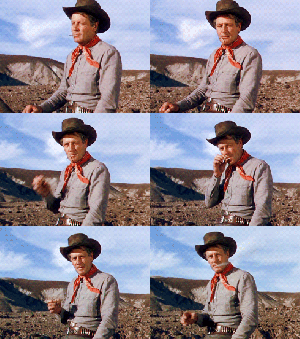
When McCrea was still very young, William Randolph Hearst chastised Louis B. Mayer for letting the actor slip from his grasp, bestowing upon him a nickname which, in its simplicity, carried great weight: the “all-American boy.” He never played anything but. In over eighty movies spanning half a century, McCrea imbued Hollywood’s homegrown forms, the romances of parlor and prairie, with the plainspoken lyricism of a man who, in his youth, plowed the field of roses where the Warner Bros. Theatre now stands, as apt a metaphor for Hollywood’s spectacular ascendance as any other, and who was secure in his conviction that good should, and would, triumph, both onscreen and off. “All I want,” he explained in Ride the High Country, his farewell picture in spirit if not in fact, “is to enter my house justified.” And this he did–with grace, humility, and a gentle honesty–again, and again, and again.
























 lauri-l